Wire EDM: Working Principle and Machine Selection Criteria
Wire EDM — sometimes referred to by its full name, wire electrical discharge machining — is a non-conventional machining process that cuts metal parts with micrometric precision, without any mechanical contact between the tool and the workpiece. Unlike die-sinking EDM, which uses a cavity-shaped electrode to erode a negative impression into the part, Électroérosion à fil : principe et choix de la machine relies on a tensioned conductive wire guided along a programmed path to erode the workpiece through successive electrical discharges. This process is aimed at shops that need to machine complex geometries in hard materials — hardened steels, carbides, titanium — to tolerances and surface finishes that conventional chip-removal processes such as milling or turning simply cannot achieve.
What is wire EDM and how does it work?
The process is based on thermal erosion caused by controlled electrical discharges between a conductive wire (the tool electrode) and the workpiece (the work electrode). Both elements are submerged in, or continuously flushed by, a dielectric fluid — typically deionized water — which serves three simultaneous functions: electrically isolating the electrodes between pulses, triggering breakdown at a precise distance when the voltage reaches the ionization threshold, and flushing eroded particles (metallic debris known as swarf or sludge) away from the cutting zone.
The discharge electrical circuit
A spark generator applies voltage pulses between the wire and the workpiece, typically in the range of 20 to 120 V, with on-time (Ton) and off-time (Toff) adjustable to the microsecond. During Ton, the voltage ionizes the dielectric in the inter-electrode gap, forming a plasma channel whose temperature can reach several thousand degrees Celsius within a few microseconds. A minute quantity of material melts and vaporizes at the surface of the workpiece — and to a marginal extent on the wire itself. During Toff, the plasma channel collapses, vapor bubbles implode, the dielectric recovers, and flushing carries away the particles. This cycle repeats at frequencies ranging from a few kilohertz to several hundred kilohertz depending on the generator settings.
Descriptive layout of the wire/workpiece/dielectric system
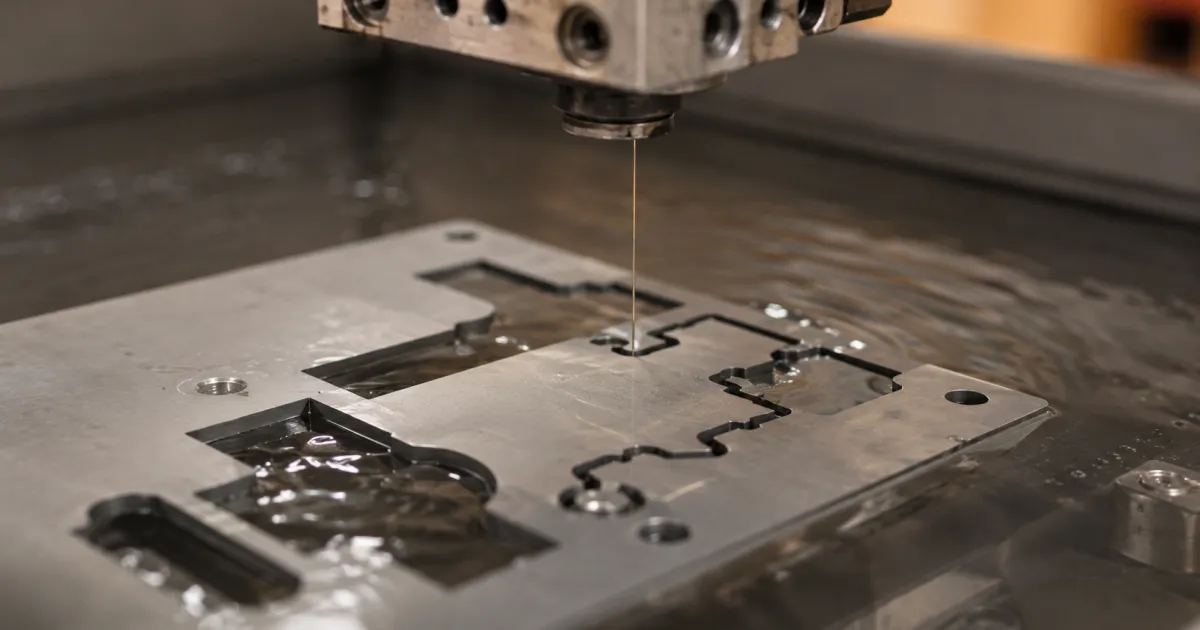
To picture the machine as a whole, the following breakdown is helpful:
- At the top: the supply spool feeds fresh wire continuously toward the upper guide.
- Between the two guides: the wire travels vertically (or at an angle for taper cuts) through the workpiece, which is clamped to the table and immersed in dielectric water.
- The gap: a space of a few hundredths to a few tenths of a millimeter separates the wire from the machined wall; this is where the discharges occur.
- At the bottom: the lower guide collects the spent wire, which is wound into a waste bin — wire is never reused.
- At the sides: flushing nozzles direct dielectric fluid under pressure into the gap from above and below the workpiece, maximizing debris evacuation.
The worktable moves along the X and Y axes under CNC control, while the guides can tilt independently (U and V axes) to produce tapered or ruled surfaces.
Key components of a wire EDM machine
The spark generator
This is the technological heart of the machine. The generator's power output and the precision of its settings — voltage, peak current, pulse frequency, duty cycle — directly determine both the material removal rate and the surface quality achieved. Modern transistor-based generators switch very rapidly, making it possible to move from a roughing pass (high energy, fast cutting, coarser surface finish) to a finishing pass (low energy, very fine Ra) in successive skim cuts along the same contour.
The cutting wire
The wire is the primary consumable. It is almost exclusively made of brass (a copper-zinc alloy) or brass coated with a layer of pure zinc or zinc oxide. Common diameters range from 0.1 mm to 0.33 mm. A finer wire improves contour resolution and reduces the kerf, at the cost of a lower allowable tension and a reduced cutting speed. Zinc-coated wire improves thermal conductivity and erosion rate. Wire tension is regulated electronically to prevent breakage.
The wire guidance system
Guide dies — diamond or carbide depending on the machine grade — position the wire to within a few micrometers. They wear gradually and represent a maintenance item that should not be overlooked when calculating total cost of ownership.
The dielectric circuit
Deionized water circulates continuously through a mechanical filtration system (filter cartridges) and ion-exchange resin treatment to maintain resistivity within a narrow range, typically between 5 and 50 kΩ·cm depending on the material being machined. A chiller unit stabilizes the dielectric temperature to limit thermal expansion and ensure the dimensional repeatability of parts.
The CNC controller
The CNC simultaneously manages axis motion (X, Y, U, V, Z), generator parameters, wire tension, flushing pressure, and any automatic wire-threading routines. Recent systems incorporate technology databases that automatically suggest cutting parameters based on the material, workpiece thickness, wire type, and required surface finish.
What materials and geometries can be machined by wire EDM?
Machinable materials
Any electrically conductive material can be processed, regardless of its mechanical hardness — which is one of the major advantages of this process over vertical machining centers or conventional milling machines, which struggle with very hard materials. Common applications include:
- Tool steels, stainless steels, and hardened steels (up to 70 HRC)
- Tungsten carbide (WC-Co)
- Titanium and nickel alloys (Inconel, Hastelloy)
- Copper, aluminum, brass
- Polycrystalline diamond (PCD) and CBN — with appropriately configured generators
Non-conductive materials (ceramics, plastics) cannot be machined by wire EDM without specific pre-treatment.
Typical geometries
Wire EDM excels at 2D and 2.5D profiles with straight walls: blanking dies, punches, mold inserts, gears, cams, and inspection fixtures. The guide tilt function (U/V axes) enables tapered cuts or ruled surfaces (extruded profiles with a varying cross-section between the top and bottom of the part). Very thick workpieces — up to 400 mm or more on certain machines — can be processed, with parameter adjustments to ensure debris evacuation across the full cutting height.
Precision, surface finish, and cutting speed: the performance figures you need to know
Dimensional tolerance
Wire EDM is one of the most precise machining processes available on the shop floor. Dimensional tolerances of ±1 to ±5 µm are routinely achieved on recent machines in finishing mode, provided dielectric temperature and machine thermal stability are properly controlled. For toolmaking or watchmaking applications, this level of accuracy is often the deciding factor.
Surface finish
The roughness achieved depends directly on the discharge energy and the number of finishing passes. A first roughing pass typically yields Ra 1.5 to 3 µm. With two to four progressively lighter finishing passes, Ra 0.1 to 0.3 µm is attainable — comparable to grinding. Some high-frequency generators enable mirror finishes of Ra 0.05 to 0.1 µm, reducing or eliminating the need for manual polishing.
Cutting speed
Speed is expressed in mm²/min (cross-sectional area cut per unit time). It depends on workpiece thickness, material, wire diameter and type, and generator power. It naturally decreases as finishing passes are applied. It is important not to evaluate the process on roughing speed alone: total cycle time always includes multiple passes, re-threading between contours, and setup time.
Technical criteria for selecting a wire EDM machine
Axis travel and load capacity
The X, Y, and Z axis travels define the maximum envelope of machinable parts. The maximum table load is a figure that is often underestimated: thick parts in steel or carbide can be very heavy. Also check the usable height between the table and the upper guide, which determines the maximum cutting thickness.
Generator power and technology
Generator power determines the roughing material removal rate. However, the quality of the discharge technology — the granularity of the settings, the depth of the technology database, adaptive parameter management — determines the ability to reach the finest surface finishes and to handle difficult materials such as carbide.
Automatic wire threading
Automatic Wire Threading (AWT) allows the machine to resume a cut after a wire break or to start a new contour without operator intervention. This is a critical criterion for unattended production (overnight, weekend runs) and for parts with numerous contours.
Positioning accuracy and repeatability
Examine the positioning accuracy and axis repeatability specifications under real operating conditions — not just laboratory conditions. The type of linear measurement system (optical or magnetic scales) and the quality of the guideways directly influence these figures.
Dielectric management and thermal regulation
An integrated, high-performance dielectric chiller is essential for high-precision applications. Check the filtration fineness on offer (cartridge pore size), the resin circuit capacity, and how easy the consumables are to replace.
Interface and connectivity
The CNC controller should be compatible with standard ISO and DXF/DWG file formats. Modern machines offer network connectivity (Ethernet, OPC-UA) for integration into a connected shop environment. The availability of technology databases covering the materials you machine is an important factor for day-to-day operational comfort.
New or used: which acquisition strategy suits your application?
Buying new
A new machine offers the manufacturer's warranty, the latest generator and CNC developments, and an up-to-date technology database. It makes sense when precision requirements are at their highest, production is intensive, or automation (wire threading, shop connectivity) is critical. The upfront cost is higher, but projected maintenance costs over the first few years are lower.
Buying used
A properly refurbished used machine can offer an excellent value-to-performance ratio for a shop diversifying its capabilities or running less intensive production. Key points to check include the condition of the guides and dies (wear), the state of the generator, spare parts availability for that machine generation, and the condition of the dielectric circuit (resins, filters, pumps). A technical inspection by a specialist technician is recommended before any purchase.
It is worth noting that wire EDM occupies a different niche from chip-removal machines. Where CNC lathes or 5-axis machining centers excel at complex, high-volume machining operations, Électroérosion à fil : principe et choix de la machine takes over for hard materials, extreme tolerances, and 2D profiles where cutting forces must be absent.
Maintenance, consumables, and total cost of ownership
Main consumables
The cutting wire is the most visible consumable: in intensive production, consumption can run to several kilograms per week depending on the diameter and cutting speeds used. Mechanical filter cartridges must be replaced regularly to maintain dielectric cleanliness. Ion-exchange resins gradually become saturated and lose their ability to deionize the water — replacement is triggered by monitoring the bath resistivity. Guide dies (diamond or carbide) wear over several hundred to several thousand hours depending on the materials machined; their replacement is critical to maintaining dimensional accuracy.
Preventive maintenance
A rigorous preventive maintenance program includes: regular checks of wire tension and flushing pressure, verification of guide alignment, cleaning of the dielectric tank, inspection of seals and nozzles, and checking positioning accuracy using a reference artifact. A well-maintained machine retains its performance over many years.
Energy consumption
Wire EDM consumes less energy per unit of material removed than a machining center running intensive milling, but it often runs continuously in unattended mode. The power drawn by the generator, the chiller unit, and the filtration system should all be factored into the annual operating cost calculation.
Service life and residual value
A well-maintained wire EDM machine retains significant residual value and has a long service life — often greater than that of a machining center subjected to vibration and cutting forces. The mechanical robustness of the machine bed and the durability of the linear guideways are factors worth evaluating over time. This argues for a TCO perspective spanning 8 to 12 years rather than focusing solely on the purchase price.
Frequently asked questions about wire EDM
What is the difference between wire EDM and die-sinking EDM?
Wire EDM uses a continuously moving conductive wire to cut a contour through a workpiece, much like a thermal wire saw. Die-sinking EDM (also called electrode EDM or ram EDM) uses a three-dimensional electrode — typically pre-machined in graphite or copper — that is plunged into the workpiece to erode a negative cavity. Both processes rely on the same electrical discharge and dielectric principle, but their applications differ: wire EDM for cut profiles, die sinking for deep mold cavities.
Can aluminum or copper be machined by wire EDM?
Yes, any conductive material can be machined. Aluminum and copper are processed without difficulty, but their low hardness means that other processes (milling, turning) are often faster and less costly for these materials. Wire EDM comes into its own when material hardness, contour fineness, or the absence of cutting forces are the determining factors.
What accuracy can be expected in routine production?
In routine production on a machine in good condition with a temperature-controlled dielectric, tolerances of ±2 to ±5 µm are consistently repeatable. Values of ±1 µm are achievable under optimized conditions (extended thermal stabilization, stable material, multiple finishing passes). These levels exceed what conventional chip-removal processes can deliver for the geometries concerned.
How many finishing passes are needed to reach Ra 0.2 µm?
This depends on the generator and the material, but the typical sequence is one roughing pass followed by two to four finishing passes at progressively lower energy levels. Each additional pass removes very little material (a few micrometers) but significantly improves the surface finish and corrects the micro-waviness left by the previous pass. The cutting program must include the corresponding offsets for each pass.
Can wire EDM replace grinding for hard parts?
For flat or cylindrical surfaces, grinding remains faster and can achieve comparable surface finishes. However, for complex shapes, closed internal profiles, or very hard materials such as carbide, wire EDM is often the only practical process — without requiring investment in expensive special tooling. The two technologies are therefore complementary rather than interchangeable.